


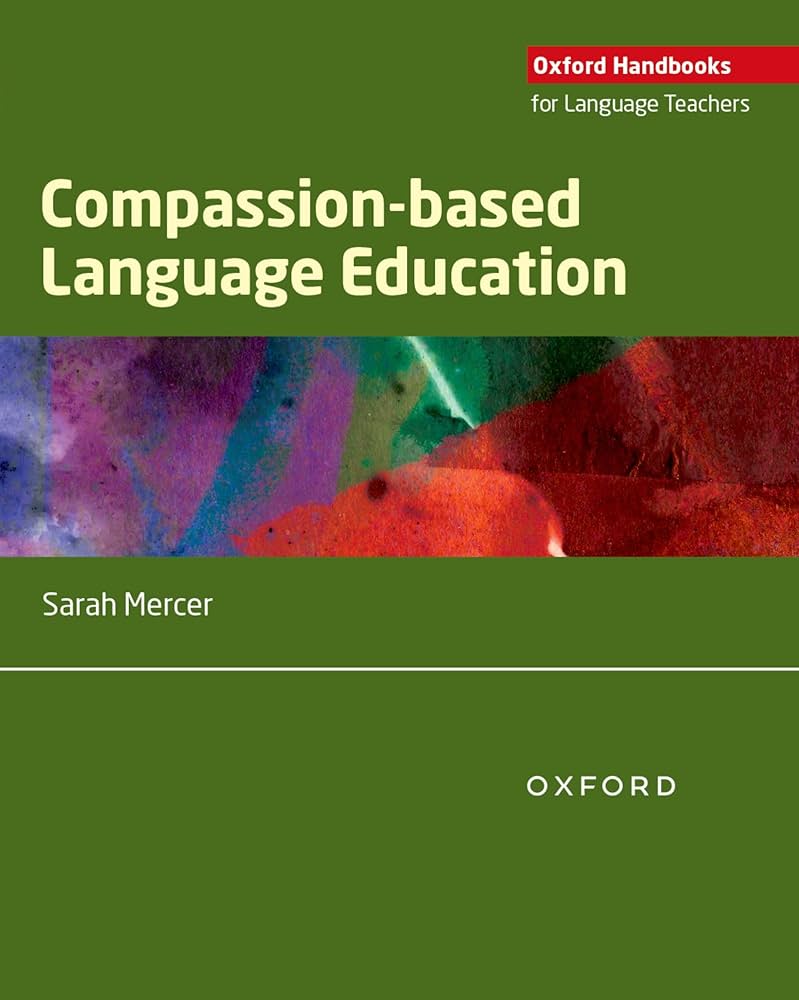
Wayne Trotman reviews Compassion-based Language Education, by Sarah Mercer.
Sarah Mercer introduces this title by describing her ideal classroom as one infused with ‘compassion’; this she defines as the psychological of imagining how others think and feel, along with being able to help them.
Whereas in Teacher Wellbeing*, (reviewed in the Gazette in issue 471) which she co-authored, the focus was on the mental and physical health of the teacher, the current title has more general aims. Firstly, to show how teaching with compassion can enhance the language learning process; and secondly to illustrate how teaching for compassion may enable the betterment of society, including more global citizenship, ecoliteracy and living a sustainable life. Whilst each are no doubt important areas, coverage of the first clearly has more direct relevance to the average ELT classroom practitioner.
How to address compassion fatigue
Following on from what she feels a compassionate language educator does (including quotes from Dalai Lama XIV) in chapter two Mercer identifies issues teachers should be aware of. Firstly compassion fatigue, when all emotional energy has been used up. This creeps up slowly when teachers are unable to give more of themselves, for example when dealing with learners who have traumatised backgrounds. In order to combat such crises, what Mercer terms ‘disconnecting from the world’ is required. This can be done by setting physical, mental and emotional boundaries between personal and professional issues, including making one’s self unavailable when necessary.
The first of the two chapters in Part One, concerning teaching with compassion focuses on teacher-learner relationships. Mercer makes explicit what for most language teachers is a feeling that develops perhaps after several years in the ELT classroom, that positive teacher-student rapport is vital and has been linked to higher levels of learner-motivation and better group dynamics. Inclusiveness is key in teaching with compassion, and Mercer (page 53) comments on how ‘One of the challenges for teachers is to build connections with all our learners and to ensure every single learner feels a sense of belonging in our classes.’ She discusses various ways of teaching inclusively so that all learners develop the three factors key to being safe and comfortable in the classroom: a sense of belonging, competence, and autonomy.
Removing implicit bias
Mercer outlines on page 54 the DEI Framework involving Diversity, Equity and Inclusion, and suggests more institutions should implement this in order to introduce a more appropriate work or learning environment by removing what she terms ‘implicit bias’ such as stereotyping. Making teaching materials more representative and inclusive involves understanding, for example, that not all English speakers represented in course materials are young, slender, not disabled, and heterosexual. Part One concludes with a focus on enhancing compassion among language learners and looks at ways of developing empathy, promoting peer relationships and group cohesiveness, and dealing with bullying.
The focus in Part Two is on developing compassion for one’s self, others and the planet. Mercer’s comments on page 107 regarding body shaming and avoiding labelling persons as ‘fat’ or ‘skinny’ are more than pertinent. The final two chapters emphasise the need for a greater emphasis on global citizenship in the form of being able to embrace diversity and promote social justice, plus ideas for living a more sustainable life by showing compassion for the natural world. This title is an excellent addition to the still growing literature on teacher self-care and caring for others. I would strongly recommend it to practising language teachers, language teacher educators plus ELT and TESOL Masters and Diploma students.
*Teacher Wellbeing, by Sarah Mercer and Tammy Gregersen. Oxford Handbooks for Language Teachers, 2020.
Compassion-based Language Education Oxford Handbooks for Language Teachers Oxford University Press, 2024
By Sarah Mercer
ISBN: 978-0-19-407074-4