

In Thailand’s northernmost refugee camp, Ban Mai Nai Soi, WEAVE‘s struggle to deliver English language education offers crucial support for displaced individuals, a story William Grice uncovers amidst tales of resilience and restriction.
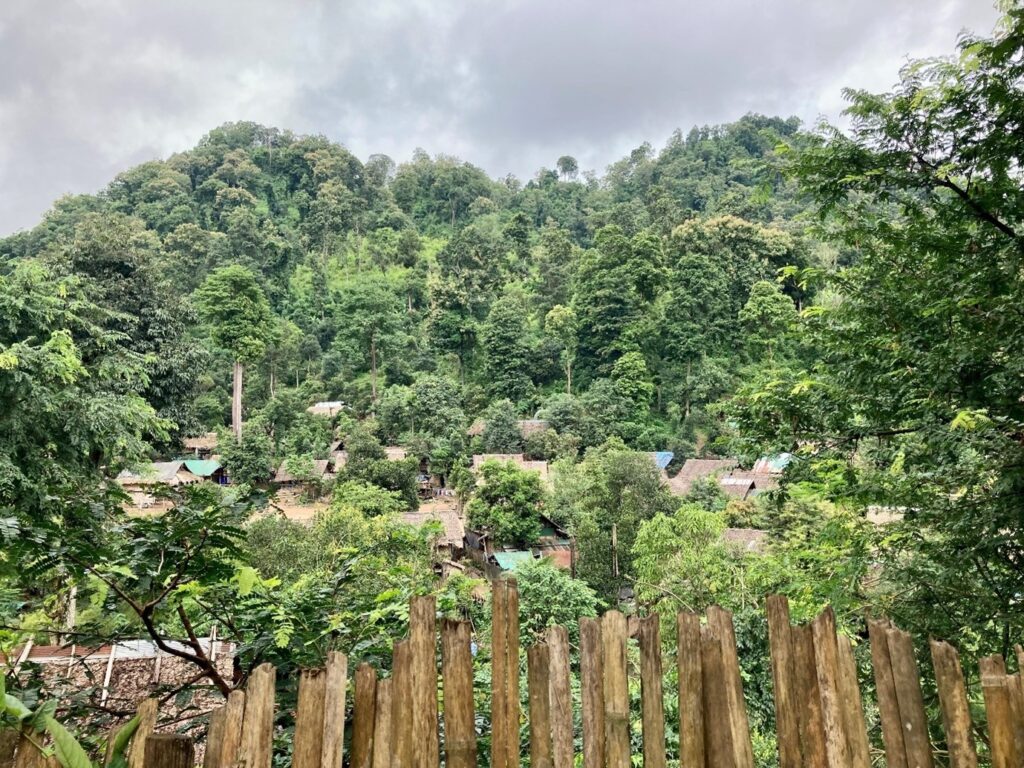
It was a sweltering day as I rattled along jungle tracks in the back of a sturdy pickup truck, traversing paramilitary checkpoints and river-crossings, when the sprawling refugee camp of Ban Mai Nai Soi finally appeared before me.
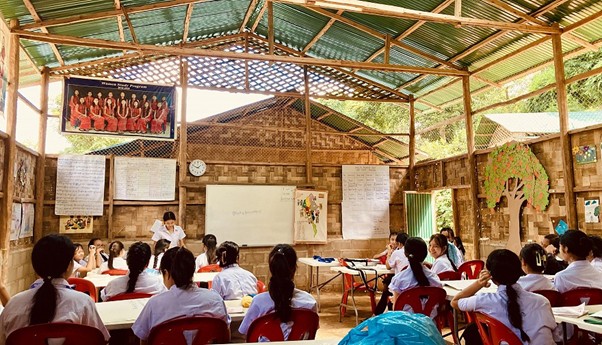
After navigating the final stretch, a shallow jungle stream strewn with rubbish, we arrived at a camp building – little more than a makeshift structure – where a local English teacher, named Rebecca, was waiting to give me a tour.
This was all part of my internship with Women’s Education for Advancement and Empowerment (WEAVE), an educational NGO empowering female refugees along the Thailand-Burma border; my role was to assist with syllabus alignment.
You see, building on insights from my previous EL Gazette article on enhancing English education in Thailand’s refugee camps, I had decided to fly out and take a more hands-on approach.
As my tour unfolded, spirited refugee girls recounted stories of supporting pro-democracy fighters in Burma, serving as medics just behind the frontlines; others spoke of fleeing their villages in Karenni State, their voices filled with pain and quiet resilience.
Later, we climbed to a hilltop school for boys, where the atmosphere was strikingly militarised, more reminiscent of secondary school Army Cadets than most ELT classrooms.
Yet, what was truly happening in this remote jungle refugee camp in northern Thailand?
And what role does ELT play in shaping young people’s lives?
From coup to camps: The conflict driving refugees to Thailand
Before we proceed, let me clarify the current situation along the Thailand-Burma border, specifically in Mae Hong Son Province, home to Ban Mai Nai Soi refugee camp.
Following a 2021 coup d’etat, Burma has faced brutal civil war between pro-democracy fighters backing Aung San Suu Kyi and the military junta led by General Min Aung Hlaing.
Since then, rebel alliances have formed and claimed key victories across the country’s ethnic states, with events on the upswing as disillusioned youth abandon Hlaing’s urban strongholds to join the resistance.
Drawing parallels with Suzanne Collins’ hit series, The Hunger Games, Burma’s breakaway states are effectively uniting against Naypyidaw just as Panem’s districts revolt against the Capitol.
What’s more, Collins’ fictional tyrant, President Snow, finds his real-world counterpart in General Min Aung Hlaing, whose oppressive rule seems only to fuel the flames of rebellion.
As a result, the Shan hills along the Thai border hide a brutal conflict, with the frustrated Burmese military, bolstered by unwilling conscripts, resorting to scorched-earth tactics.
This has driven Karenni refugees east across the Salween River from Karenni State into Thailand, seeking refuge in Ban Mai Nai Soi, one of four camps in Mae Hong Son Province.
Control and crisis at Ban Mai Nai Soi
Deep in the jungle at Ban Mai Nai Soi, then, 10,000 mostly women and children are confined to bamboo huts in prison-like conditions, without running electricity or proper infrastructure.
Why is this the case? How can this happen in a country that attracts millions of tourists each year and is a major ELT destination?
Well, Thailand’s Ministry of Interior enforces these conditions through a Camp Commandant, currently Sitthipon Manchai, and his paramilitary forces from Military Taskforce 17.
The country’s refusal to ratify the U.N. Refugee Convention and strict oversight by its National Security Council (NSC) over all educational activities only compound the issues.
Plainclothes officials frequently visit organisations like WEAVE, for instance, interrogating staff and closely monitoring operations; something I observed firsthand in Mae Hong Son.
Meanwhile, the regular Thai Army patrols the frontier where they forcibly returning refugees, aka, refoulment, perhaps influenced by old friendships between Thai and Burmese generals.
This combination of military pressure and bureaucratic oversight creates a complex political environment for refugees, teachers, and syllabus designers; especially those working in ELT.
WEAVE’s work on the border: Education under surveillance
Since 1990, WEAVE has supported ELT along the Thailand-Burma border, primarily helping the Karenni National Women’s Organisation (KNWO) provide democratic citizenship education in its camp schools via a Women’s Studies Program (WSP).
English plays a central role, offering refugees a pathway to further education, employment, or resettlement; however, in Ban Mai Nai Soi, language choices are fraught with complexity.
In multilingual refugee camps, language learning is never neutral: Burmese is seen as essential for a future federal democracy but is also the language of the junta.
Speaking Kayin, the mother tongue, reinforces identity, while learning Thai is actively discouraged to prevent assimilation.
Navigating these complexities is just part of the challenge; despite funding from major donors like Oxfam and UNHCR, WEAVE operates under intense scrutiny, with limited resources, while ELT practitioners face stringent restrictions.
The NSC oversees all educational, humanitarian activities, meaning every aspect of ELT – from syllabus content to teaching methods and foreign instructors – requires approval.
I encountered these constraints firsthand during my internship.
My work on WSP syllabus alignment ensured ELT complemented other modules, yet unreliable Wi-Fi, overburdened teachers, and traumatised students made balancing educational goals with reality a constant struggle.
Ultimately, Thailand’s Ministry of the Interior controls Ban Mai Nai Soi, prioritising repressive authority over education, turning syllabus mapping into an uphill battle within a system that keeps refugees in perpetual limbo.
This all seems by design.
Camp commandants, corruption, and constraints
Thailand’s broader political environment clearly exacerbates the challenge of delivering ELT, and recent changes in camp leadership raise additional concerns among educational NGOs.
Anonymous sources I spoke to often noted that transfers, such as moving a civil servant from Thailand’s south to a quieter post, often reflect underlying issues within Thai administration.
This concern is especially relevant in Ban Mai Nai Soi, where critics fear corruption under the recently appointed Commandant, Sitthiphon Manchai, who wields vast power over 10,000 stateless refugees.
Alleged corruption is compounded by human rights abuses, like a 2002 incident reported by the Asian Human Rights Commission in which Thai guards raped two Karenni refugee girls.
During my stay, an ELT curriculum designer from Mote Oo Education suggested that Thai authorities had later restricted camp access after the victims sought justice over hush money.
Though shared off the record, this likely explains why WEAVE’s ELT interns still require Camp Passes from Manchai’s office, adding another barrier to education in the camp.
WEAVE’s CEO, Mitos Urgel, underscores worsening conditions for Karenni refugees post-coup, with tighter movement restrictions, labour laws, and health challenges directly affecting students’ ability to attend ELT programmes.
She refrained from commenting on Thailand’s historic human rights abuses, Commandant Manchai’s previous role, or the NSC during my time at WEAVE, but her silence was telling.
The Thai government’s economic and political ties with the junta, coupled with undemocratic repression of NGOs, overshadows humanitarian and ELT concerns along the border.
Underlining all this, Britain’s Foreign Office FoI records reveal that, prior to Thailand’s recent elections, its military conducted regular joint exercises with Burmese soldiers.
Despite FOIA Section 27 redactions, this insight also speaks volumes, and I only hope British diplomacy defends refugee rights rather than prioritising political and economic interests.
After all, ELT in Thai camps is a fragile lifeline amidst the harsh realities of conflict and control, and this article for EL Gazette shines just a modest spotlight on a wider global issue.
One that too often remains in the shadows.
If you want to support or learn more about WEAVE and volunteering opportunities, please visit the website or contact Mitos Urgel, WEAVE’s director, at [email protected].
This was originally published in the May 2025 issue of EL Gazette.