



A new report from QS highlights how Indian demand for study abroad is expected to continue to shift through 2030, and adds some helpful forecasts to recent analysis of the changing landscape for student recruitment in India.
QS describes “a gradual reshaping of Indian student mobility by 2030” where the Big Four destinations remain central but with very different positions on the leaderboard. The UK is projected to overtake Canada and the US as the top destination for Indian students. Otherwise, key destinations in the EU are projected to see the fastest growth in Indian enrolments over the rest of this decade – albeit from a smaller base.
Further: “With transnational education and international branch campuses set to expand and mature in India, we could see further mobility changes,” cautions the report. “By 2030, significant volumes of Indian students may study at the branch campuses of international institutions, rather than travelling overseas.”
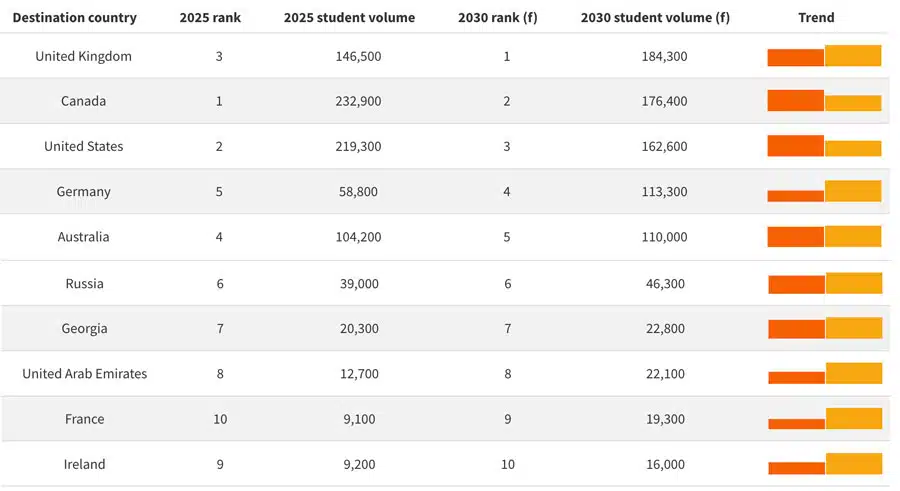
Indian student mobility for 2025 (actual) and 2030 (projected) for the top ten destinations. Source: QS Global Student Flows.
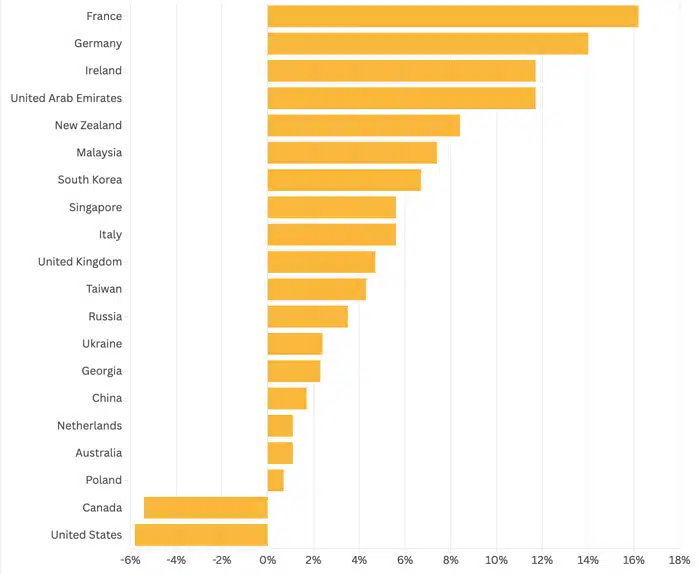
Compound annual growth rate (CAGR) of selected destinations, 2025–2030. Source: QS Global Student Flows.
The overall picture is one of a broadening and more balanced distribution of Indian students, both within the Big Four and otherwise. While Canada and the US are both projected to see their Indian enrolments decrease through 2030, they continue host significant numbers. Germany is projected to see the largest gains with a forecast to nearly double its Indian enrolment, at which point it will have surpassed Australia as the fourth-largest host of Indian students.
“Demand from Indian students looking to study in the ‘Big Four’ is expected to remain substantial,” says QS. “But students’ choices are likely to be shaped by affordability, visa policy, post-study work opportunities and perceptions of long-term value.”
Please read the full article on ICEF Monitor, where it was originally published.