

Combing through the pedagogical offerings I’ve reviewed for various ELT organsiations over the past twelve months, three topics have become increasingly noticeable: inclusion, diversity and translanguaging. As of today, though, I’m officially adding a fourth – this is by now the much-lauded / much-maligned (tick as appropriate) artificial intelligence, aka ‘AI’.
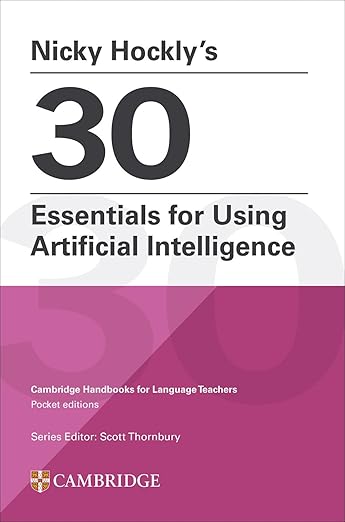
As I personally find AI very disturbing, it’s a topic I notice I’ve been actively avoiding by, for example, skipping seminars on this area and keeping my review copy of Nicky Hockly’s title well out of sight. On reflection, though, what an eye-opener reading it turned out to be!
In the introduction to the 30 brief but hugely informative chapters, Hockly – a highly-regarded IT for ELT specialist – explains how she first encountered AI as far back as the early 1980s when she was a student. Most of us, however, perhaps encountered AI for the first time (and with a bang) during the introduction of the translation tool called ChatGPT in late 2022.
Happily, in ‘Setting the Scene’ she demystifies matters for techno-dinosaurs like me by explaining clearly and on a basic level exactly what AI is and how it works. Also considered there are reasons why educational technology tends to be over-hyped and how those in the ELT field should resist this.
The following chapter explores the possibility and extent to which AI can support the classroom teacher, and the clearest means of assistance is of course in the form of generating tailor-made lesson plans. Interestingly, Hockly looks at how emotion AI in the form of sentiment analysis can measure learner engagement. This was all becoming a little bit beyond my cerebral capacity, but apparently by using cameras certain features of AI can detect and measure how much, for example, readers of this review are appreciating the experience; so, mind your facial expressions out there!
Moving next into much deeper waters in ‘The Big Questions’, Hockly considers ethical, philosophical and legal issues related to AI, such as how to make sure it is accessible to all, and not just the usual privileged elite. Other thought-provoking topics here concern how AI enables cheating, especially with written homework assignments.
The solution is of course to accept only work produced (and preferably written by hand) during classroom time. The potential for cheating is of course not limited to students. As a result of the AI translation tools now available, I’ve noticed a huge decline in recent years in the number of academic articles I’ve been asked to proof-read. I wonder why!
It wasn’t until I had reached the final section that I realised there were a further two currently ubiquitous but necessarily valuable topics emerging amongst books for teachers: keeping it green and protecting the well-being of all involved. Hockly points out how digital technologies have an environmental cost that is often conveniently glossed over, and the importance of protecting learners in particular from unscrupulous persons accessing their data. This concise and easily portable handbook is another valuable addition to a very impressive series from Cambridge.
30 Essentials for Using Artificial Intelligence
By Nicky Hockly
ISBN: 978-1-009-80452-3
Cambridge Handbooks for Teachers, 2024
More from Wayne Trotman