


Siyue Zhang (Amber) examines the power of game-based tasks in opening translanguaging spaces for adult Chinese learners in online English-speaking environments.
In many adult EFL classrooms – especially online ones – teachers are still encouraged, explicitly or implicitly, to keep interaction as “English-only” as possible. The assumption is familiar: the more exposure learners receive, the better their English will become. Yet in informal learning spaces, this ideal often clashes with how learners actually communicate.I encountered this tension repeatedly while facilitating an online English corner for adult
Chinese learners. These weekly sessions were not exam-driven classes but informal speaking spaces, combining discussion, cultural topics, and game-based activities. It was in these game moments that something interesting happened.
As soon as guessing tasks, riddles, or roleplay activities were introduced, English and Chinese began to circulate fluidly. Learners switched languages to clarify rules, negotiate meanings, joke with peers, or support one another under time pressure. Rather than derailing interaction, these shifts often helped the activity move forward.
This article draws on a small-scale qualitative case study to explore how game-based learning (GBL) opens translanguaging space in online English learning, and what this means for everyday teaching practice.
Seeing translanguaging where teachers usually notice it
Discussions of translanguaging often begin with theory, but for teachers it usually shows up in far more ordinary moments – when learners hesitate, clarify, or quietly help each other mid-task. Research has described translanguaging as the flexible use of multilingual resources for meaning-making, reflection, and social connection (García & Li; Li Wei).
In practice, however, it is still frequently framed as something to be tolerated rather than designed for. Game-based learning offers a useful lens here. Games naturally introduce challenge, time pressure, collaboration, and emotional engagement. In language classrooms, they also create moments where learners need to think quickly, negotiate meaning, and manage anxiety – conditions that often invite strategic language shifting.
While both translanguaging and GBL have been widely discussed, they are rarely examined together at the level of task design. To explore this connection more concretely, I developed a Dynamic Translanguaging–GBL(DTGBL) framework, which links how games are designed with how learners actually use language during play.
How the DTGBL framework works: from “allowing” translanguaging to designing for it
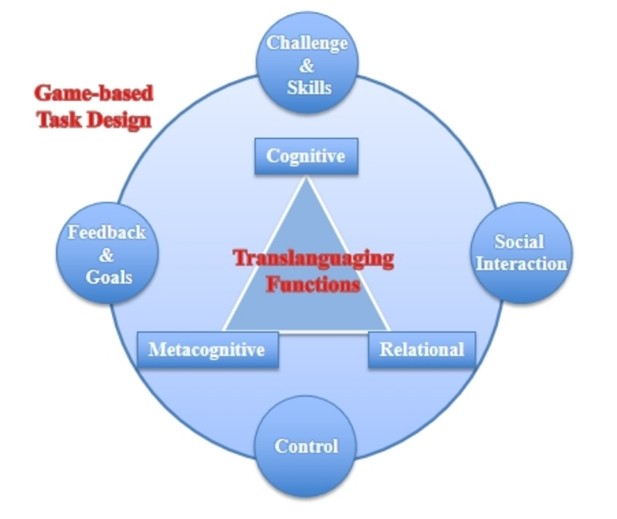
The Dynamic Translanguaging–GBL (DTGBL) framework illustrates how core game design elements – such as challenge, feedback, learner control, and social interaction – tend to activate different translanguaging functions during classroom gameplay. Rather than treating language switching as incidental, the framework highlights how task design shapes when learners draw on cognitive, metacognitive, or relational language resources.
The framework brings together two perspectives (see Figure below). On one side are three commonly observed translanguaging functions:
- Cognitive (understanding concepts, solving problems)
- Metacognitive (reflecting on language use and strategy)
- Relational (building rapport, humour, emotional support)
On the other side are simplified game design elements adapted from the GameFlow model (Sweetser & Wyeth): balanced challenge, clear goals and feedback, learner control, and social interaction. The framework does not claim that each game element produces a fixed outcome; instead, it helps explain patterns that repeatedly emerged during classroom interaction.
What happens when games meet bilingual repertoires
The data comes from six recorded online English corner sessions involving six adult learners with intermediate to upper-intermediate proficiency. Activities included guessing games, bilingual riddles, role-play, and discussion-based challenges.
What stood out across activities was not how often learners switched languages, but what those switches were doing in the interaction.
Relational: creating safety through play
Games consistently lowered the emotional stakes of speaking. Teachers often used brief Chinese phrases for praise or humour -“很棒Good for you!” or “这个提示太有中国味了That’s really CHINESE~” – before returning to English instructions. Learners reported that such moments reduced anxiety and made participation feel less exposed.
Rather than interrupting English practice, relational translanguaging helped sustain engagement. One learner noted that when teachers joked briefly in Chinese, speaking English afterwards felt less intimidating.
Cognitive: solving problems together
Translanguaging became particularly visible when tasks involved cultural references or abstract vocabulary. In a riddle game about traditional foods, one learner asked in Chinese whether “sticky rice” referred to 糯米 before confidently giving the answer in English. In another session, while playing Who Is the Undercover, learners debated the difference between face and pride. One learner suggested face as something you “lose in public”, while another hesitated, unsure how to express this idea clearly in English. A short exchange in Chinese followed, after which the group settled on a clue that everyone understood. The game moved on, but the discussion lingered.
These brief shifts allowed learners to bridge conceptual gaps efficiently. Instead of stopping the task, translanguaging functioned as a problem-solving resource that kept gameplay moving.
Metacognitive: talking about language itself
Games also created space for explicit reflection on language use. Teachers frequently explained grammar or strategy in bilingual form, embedding English examples within Chinese explanations. At times, they explicitly legitimised strategic choice: “You can speak Chinese but try to use as much English as you can.”
These moments show translanguaging operating at a metacognitive level, helping learners monitor their language use and make conscious decisions under real-time pressure.
How game design opens translanguaging space
Viewed through the DTGBL framework, translanguaging did not occur simply because learners shared an L1. It was invited by task design.
Balanced challenge encouraged cognitive translanguaging as learners drew on all available resources to solve problems.
Clear goals and feedback, often delivered bilingually, supported reflection and reduced performance anxiety.
Learner control allowed participants to decide when switching languages was useful rather than penalised.
Social interaction – especially collaborative guessing and role-play – strongly activated relational translanguaging through humour and peer alignment.
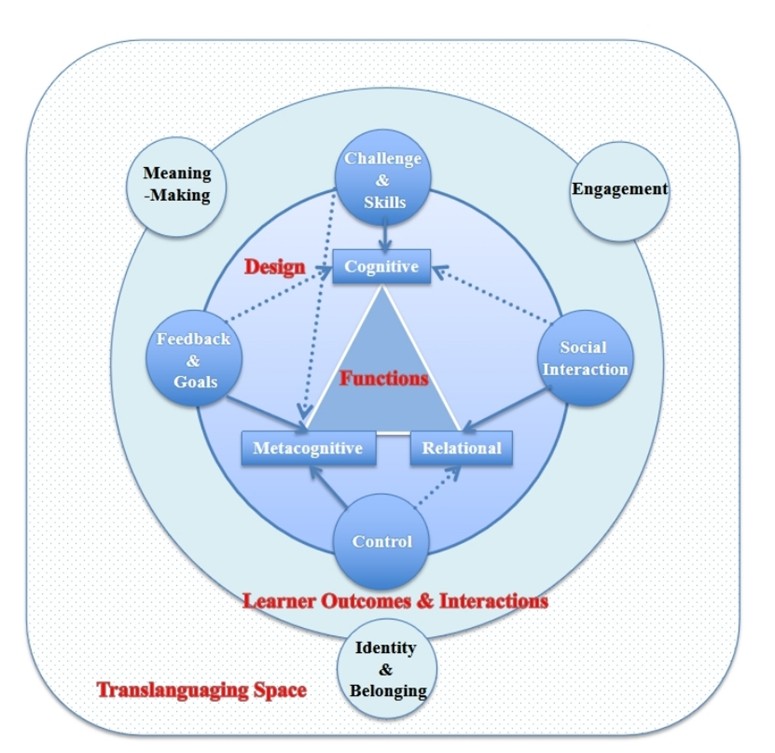
Together, these conditions fostered what Li Wei describes as a translanguaging space (see in Figure): an environment where multilingual practices are not only permitted but meaningful and purposeful. Importantly, this space did not emerge accidentally. It was co-constructed through task structure, teacher mediation, and learner agency.
Implications for classroom practice
For practitioners, the takeaway is not simply that games “allow” translanguaging, but that they can be intentionally designed to work with it.
Tasks that involve conceptual ambiguity or cultural interpretation invite learners to engage cognitively across languages. Bilingual scaffolding and feedback can support reflection without undermining English use. And relational talk – jokes, encouragement, informal comments- should be recognised as part of how learners build confidence and belonging.
When games are designed in this way, learners often end up producing more English-not despite using their first language, but because of it.
At the same time, tensions remain. In fast-paced competitive games, learners sometimes relied heavily on L1 for speed or humour, reducing English output. This suggests that translanguaging-rich classrooms still require thoughtful facilitation to balance engagement with language learning goals.
Final thoughts: designing for multilingual reality
This case study suggests that in online, game-rich classrooms, translanguaging is not a problem to be managed but a resource to be designed for. When tasks are structured around challenge, interaction, and feedback, learners naturally draw on their full linguistic repertoires to think, reflect, and connect.
Rather than asking whether translanguaging should be permitted, educators might ask a more productive question: what kinds of tasks invite learners to use language in ways that genuinely support learning? Game-based learning offers one compelling answer.
References
García, O. & Li, W. Translanguaging and bilingual education.
Li Wei. Translanguaging as a practical theory of language.
Sweetser, P. & Wyeth, P. GameFlow and player engagement in games.
About the author
Zhang Siyue (Amber) holds an MA in TESOL from University College London (UCL Institute of Education) and is a multilingual English language educator with teaching experience in the UK, China, and online contexts.
Her research interests include second language acquisition, translanguaging, and game-based learning, and she explores how these inform practical teaching in online EFL classrooms.
This article is adaptation of a presentation she gave at the 6th International Conference on Language Education and Research (LERC2025).
This article was first published in the Jan/Feb issue of EL Gazette.