

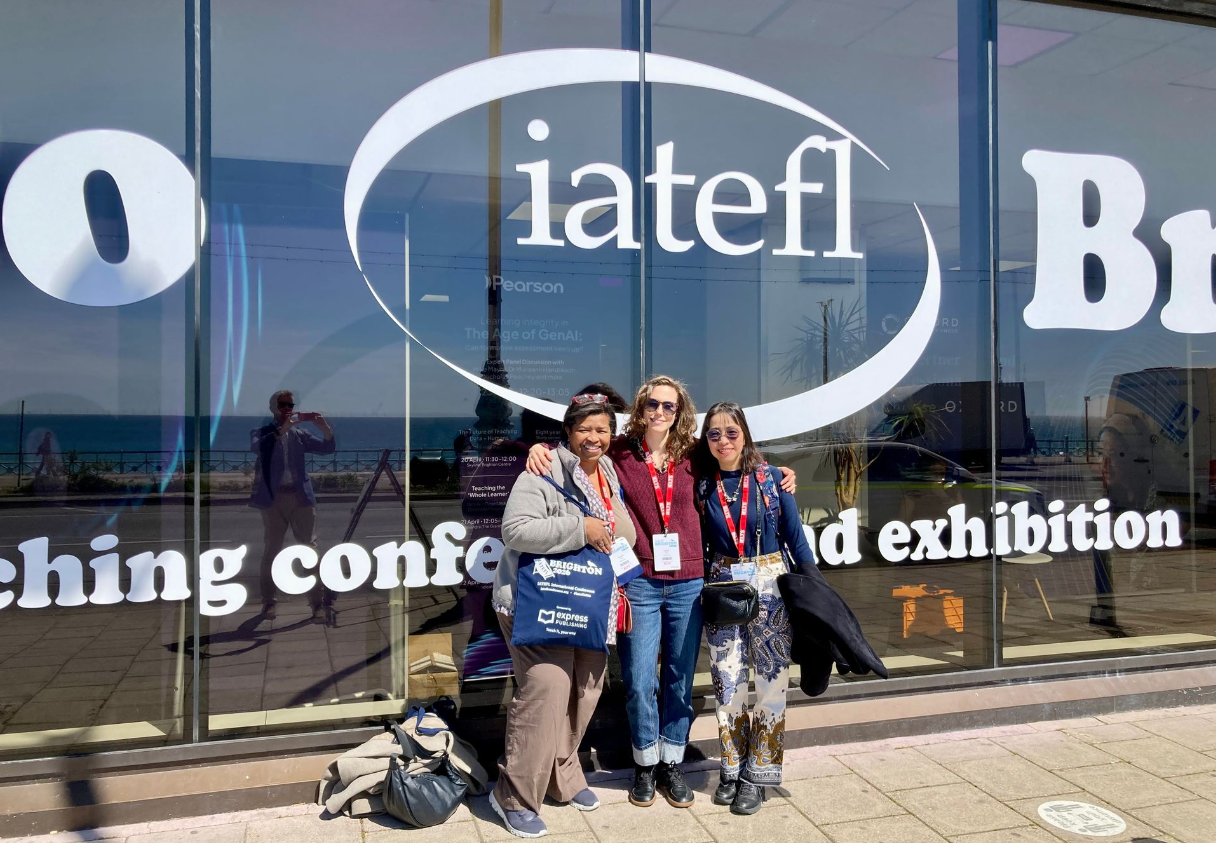
EL Gazette Publisher, Ian Carter and Editor, Becci Knowles walked both floors of the lively exhibition that ran alongside IATEFL Conference to bring you this exclusive report.
The English language teaching world descended upon the vibrant seaside resort of Brighton in April for the highly anticipated IATEFL International Conference and Exhibition. Making our way through the bustling exhibition area, it was impossible to miss the extensive presence of Oxford University Press (OUP), who served as the official Conference Wellbeing Partner this year. We sat down with Richard Grazier, the global sales & marketing director, who has been in his role for 14 months. OUP offers complete solutions for English Language Teaching and Assessment, delivering learning materials, assessments, and teacher development resources to cover every stage of the learning journey. Richard explained that OUP’s current strategy focuses on lifelong learning rather than being limited strictly to textbooks, stating that, “Our overall strategic position isn’t isolated to a single product. We see our role as supporting teachers and the teaching community.”
Richard highlighted that the industry is filled with plenty of content but faces a distinct shortage of teachers and time, making human connection and peer learning more important than ever. In discussing OUP’s presence at IATEFL and its upcoming 100th anniversary of excellence in English language teaching, he noted that the company’s
core approach is built on trust, explaining that “the biggest thing is to listen. The world of English language teaching is always adapting and evolving, but our core skill – listening – hasn’t changed.”
Bridge Education Group
Further along the show floor, we caught up with the Rachel Story, marketing manager at Bridge Education Group to see how its international presence is shaping the current training landscape. The US-based company specialises in TEFL/TESOL certification and professional development, providing online teacher training and classroom-ready resources for aspiring and experienced English teachers across more than 140 countries. Bridge also partners with organisations to deliver corporate language training programmes for employees.
“Most conversations have been about what we do and so it’s been great for networking and brand awareness,” said Rachel.
King’s College London
King’s College London (KCL) maintained its prominent, longstanding position at the event. We had the pleasure of speaking with Dr. Joe Fagan, senior lecturer in Applied Linguistics and programme director for the MA in Teaching English to Speakers of Other Languages (TESOL). KCL delivers an academically rigorous MA TESOL programme that offers hands-on experience and professional development.
Joe outlined KCL’s strong history of community engagement at the exhibition and how
integrated its academic network is with the event’s schedule, stating, “We are very proud that Richard Chinn, a PhD student and teacher on the MA programme, gave one of the conference plenaries on the topic of Emergent Language. We also see former students coming back to give presentations, so KCL has quite a prominent position within the community.” Looking ahead to programme developments, KCL is putting a
significant strategic focus on its on its online provision and summer short courses.
Helbling English
Helbling English stood out with its focus on practical classroom applications and new secondary school materials. The company develops flexible, integrated ELT educational solutions designed to make the language learning experience both motivating and enriching for teachers and students alike. The primary highlight for Helbling at this
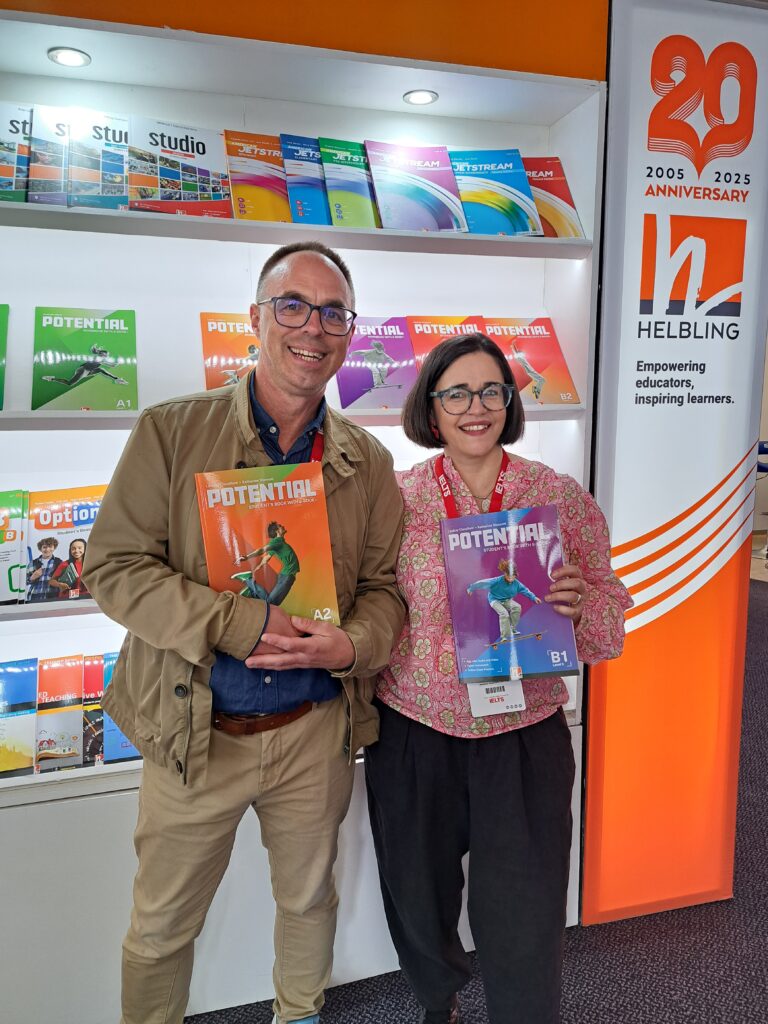
Authors Lindsay Clandfield and Katherine Stannett with the book
year’s conference was promoting POTENTIAL, its brand-new coursebook tailored for upper-secondary schools. The company highlighted the core methodology behind the book – which focuses on helping students consolidate past learning while preparing for what comes next – through a practical presentation by Lindsay Clandfield.
The team noted that managing mixed learning environments remains an operational hurdle, observing that, “One of the main challenges teachers consistently report is managing mixed-ability classrooms while still ensuring meaningful progress for every
learner.” Helbling addresses these pain points by offering structured, inclusive resources like its lower-secondary coursebook, OPTIONS, moving away from a one-size-fits-all
approach to learning without adding to teacher workload.
Cambridge University Press & Assessment
Another major highlight on the exhibition floor was Cambridge University Press & Assessment, where the conversation focused on integrating testing with day-to-day teaching and learning. We connected with Graham Seed, senior research manager for
Cambridge English, and reviewed key takeaways shared by Dr Brigita Seguis, head of Impact Evaluation. Cambridge delivers expertly created, integrated English learning and assessment solutions to schools, universities, and companies globally. Discussing how the line between testing and learning is (rightly) blurring, Graham observed that, “They
used to be regarded as two separate animals, but learning and assessment are part of the same ecosystem.”
Cambridge experts spent the week interacting with hundreds of delegates to address evolving challenges in lesson design, accessibility, and teacher development, Dr. Seguis said: “This year our experts spoke to hundreds of delegates on a range of areas where we are strengthening our support, including effective lesson design, learner engagement, teacher development, accessibility and inclusion, and the integration of wider competencies in language education.” A major focal point for Cambridge was the ethical, human-centred implementation of AI in the classroom, emphasising that technology must support critical thinking without diminishing the foundational role of teachers and textbooks, while also celebrating its 2026 scholarship winners, Indeewari Mendis, winner of the Cambridge University Press & Assessment Scholarship, and Tram Nguyen, winner of the IELTS Morgan Terry Memorial Scholarship 2026.
NILE (Norwich Institute for Language Education)
A well-timed stop brought us to the NILE stand, where teacher training qualifications were front and centre. We spoke directly with Director Thom Kiddle. NILE is one of the world’s largest providers of professional training and development for English language teaching, offering specialised courses and consultancy for educators worldwide. Thom explained that attending the conference is an absolute necessity for industry presence. “For us it’s about visibility. We’ve been attending for 30 years now, and IATEFL is the one date in the annual events calendar when you are going to meet everyone and keep your finger on the pulse of the sector. If we didn’t come, we would be conspicuous by our absence!” He was keen to talk about NILE’s latest and much needed qualification, developed in partnership with The AI Board. The Award in Artificial Intelligence for Teaching Professionals, “enables you to critically explore the opportunities and risks presented by artificial intelligence (AI) in teaching, learning and assessment,” he said.
Express Publishing
Over at Express Publishing we spoke with Konstantina Skoulika, the company’s marketing manager. Express Publishing provides comprehensive educational series, skill-specific resources, and digital tools that reach students in over 120 countries, integrating CEFR standards with modern methodologies like STEAM, CLIL, and inquiry-based learning. The big talking point for the company at this year’s show was its complete corporate re-branding. To celebrate this milestone, Konstantina shared that they organised “an exclusive dinner to celebrate our rebranding with members of the IATEFL community and conference attendees”.
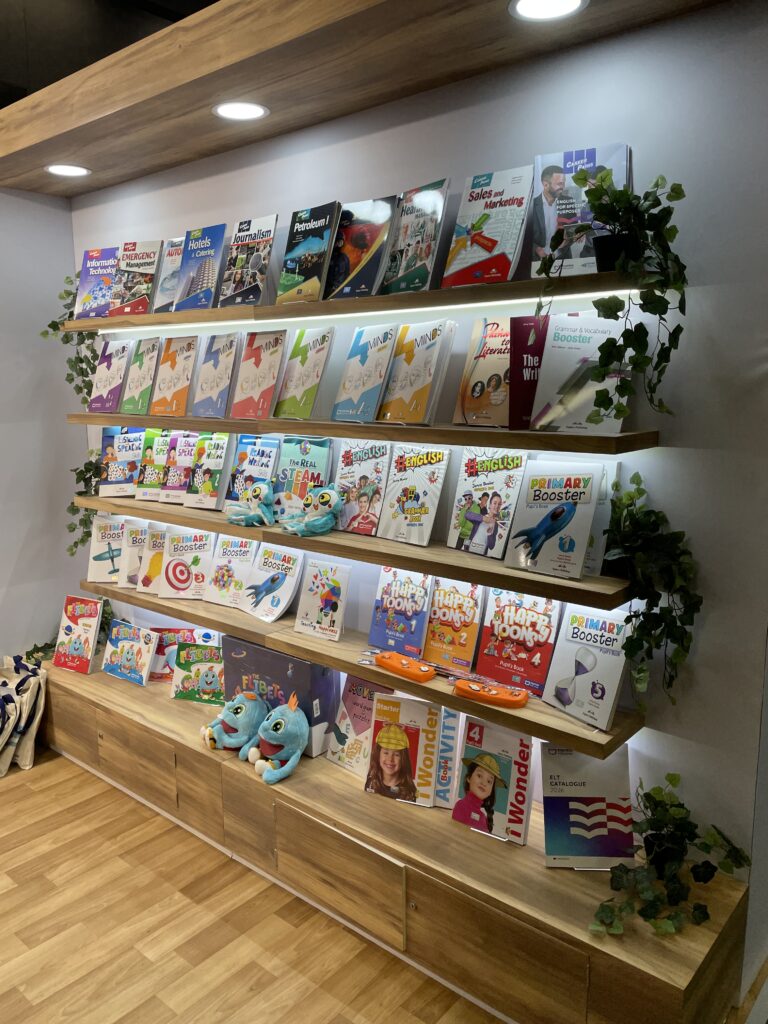
Just some of the titles available from Express Publishing
Chief Marketing Officer, Virginia Dooley, continued: “This year, we again had the chance to attend IATEFL in Brighton and it was a special one at that! We put our brand-new logo up on our stand – a reminder that while our legacy continues to inspire us, we are always discovering new paths to create materials that inspire millions of students and teachers across the world to unlock knowledge, possibilities, adventures.” Virginia wrapped up by saying, “And of course we were happy to sit down with educators from around the world and listen to what they think classrooms are like in 2026, what their challenges are and how much better everything feels when the Brighton sun is on your side!”
Avallain
At the Avallain stand, we spoke to VP Partnerships’, Ian Johnstone, and Business Development Manager, Stephen Madden, about the massive technology shift
occurring in educational publishing driven by AI. Avallain is a leading provider of digital education solutions across multiple sectors, including ELT. Its ecosystem features Avallain Author (an AI-powered authoring tool), Avallain Magnet (an AI-integrated LMS), and TeacherMatic (an AI toolkit designed specifically for educators). Detailing how generative AI is driving a shift toward highly personalised, localised learning content, Ian said, “It’s super useful to speak to the publishers here. They know [AI] is going to change their market, and
it’s our job as a leading technology provider in education to build a roadmap for that horizon.”
To counteract teacher anxiety about AI and avoid patchy, inconsistent tech use across
institutions, Avallain acquired TeacherMatic, which features purpose-built generators (such as Lesson Plan, Worksheet and Advanced Feedback generators) to safely scaffold content creation. Stephen demonstrated how this supports usage, explaining, “So instead of teachers having to prompt, the tech can do this for them.”
LanguageCert
At LanguageCert, we met with Sylvia Karastathi, head of teacher support, who described the organisation’s wider commitment to building and supporting a global community of English language teachers. Alongside delivering CEFR-aligned English language
qualifications for study, work, and migration, LanguageCert runs an extensive programme of teacher webinars, events, and professional resources designed to support educators throughout the qualification journey and beyond. Sylvia explained that the organisation structures its teacher support around three core strands: webinars, teacher events, and classroom resources. “For me, the vision and the dream is to support and build a community of language teachers that feel empowered in their roles,” she said, adding that
LanguageCert also aims to respond to the wider needs of the teaching profession across different regions and educational contexts.
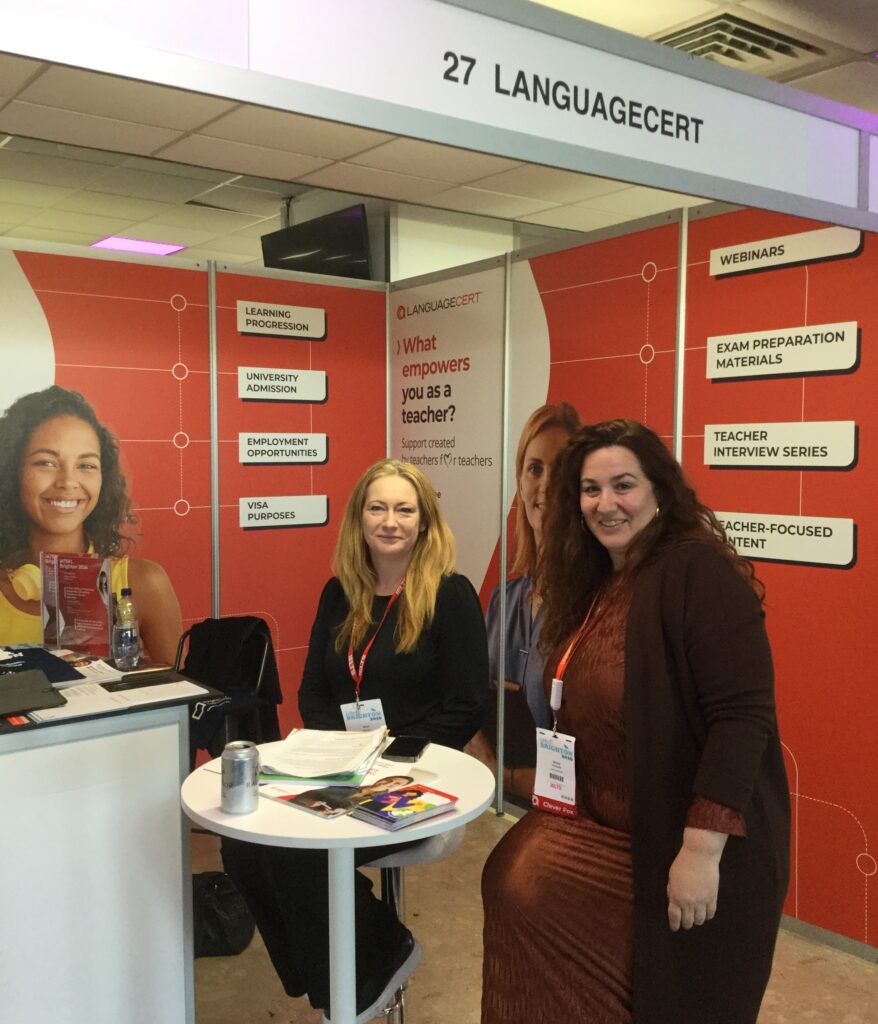
Editor, Becci Knowles speaks to Sylvia Karastathi
At this year’s IATEFL conference, the organisation focused heavily on teacher empowerment, while also showcasing ideas explored throughout the academic year in its
ongoing webinar programme. Sylvia’s own presentation, Human Writing in Transition: Multimodal Life-Writing Practices, explored concerns around the future of human writing in
an increasingly automated world, encouraging teachers to focus more on authenticity, process, and multimodal expression within writing instruction.
Sylvia also highlighted LanguageCert’s growing international outreach, including its expanding work with teaching communities in Australia and across the Asia-Pacific region, describing these collaborations as essential to shaping the organisation’s global perspective. “These global collaborations nourish our headquarters,” she said. “We’ve got
people bringing us their insights and perspectives, and through these we’re able to better understand this big global puzzle we operate in.”
Duolingo
Duolingo shared how it is carving out a distinct space within institutional language testing. We spoke with Sophie Wodzak, the senior communications manager for the Duolingo English Test. Duolingo provides digital-first testing options, with its primary product being a certified, specialist English test that has achieved acceptance across every Ivy League university. Sophie explained the unique branding challenges they face because of the parent company’s massive global footprint, noting that, “Duolingo is 15 years old, so we have been building out brand awareness for over a decade. 10 years ago, we launched the test. It was kind of slow going in the beginning, because, again, it’s a niche product. It’s a specialist industry.” She detailed how she works to distinguish the rigorous academic credentials of the test from the casual nature of the primary learning app, adding that, “People associate us more with the app, so that’s really the work I do, to say we also have this other product. It’s a certified test, accepted by every Ivy League university and others. There’s been a lot of interest in the test here at IATEFL.”
British Council
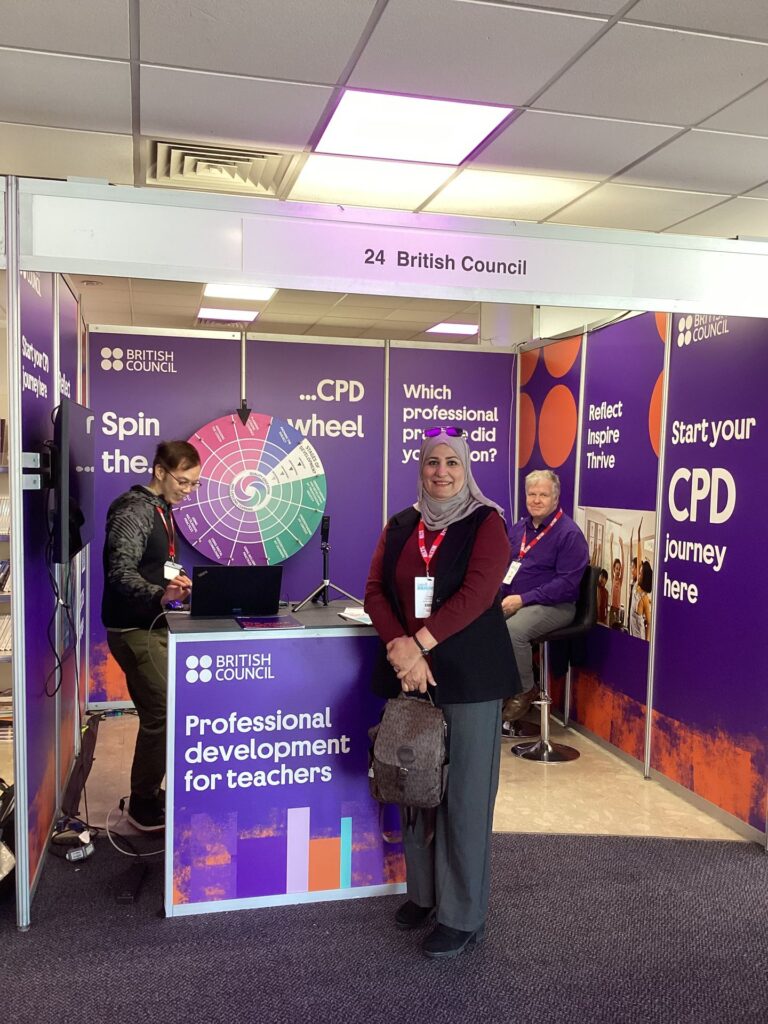
We were pleased to meet with representatives from the British Council, including Helen Mehta, stakeholder engagement lead, Alison Devine, head of English Connects and Vanessa Komiliades, head of professional development. The British Council runs TeachingEnglish, a huge global programme and resource ecosystem for English teachers and teacher educators that provides lesson plans, live events, courses, podcasts, videos and publications to support individual practitioners to develop their skills and knowledge and improve classroom practices in English language teaching. The team spent the conference highlighting this, alongside its recently refreshed CPD framework which has been updated to reflect the evidence outlined in the British Council’s 2025 report What’s changed in English Language Teaching?, recognising how the field has evolved over the past decade and supporting a more responsive approach that values individual teacher strengths.
Inviting visitors to spin “the CPD wheel,” Vanessa Komiliades showed us how the new framework reinforces a more personalised approach to professional development, empowering educators to take an active role in their own learning and career growth. In tandem with this rollout, they showcased the upcoming launch of their latest positioning paper, Language-responsive education, which focuses on inclusive language policy and practice and went live on 6 May.
Pearson
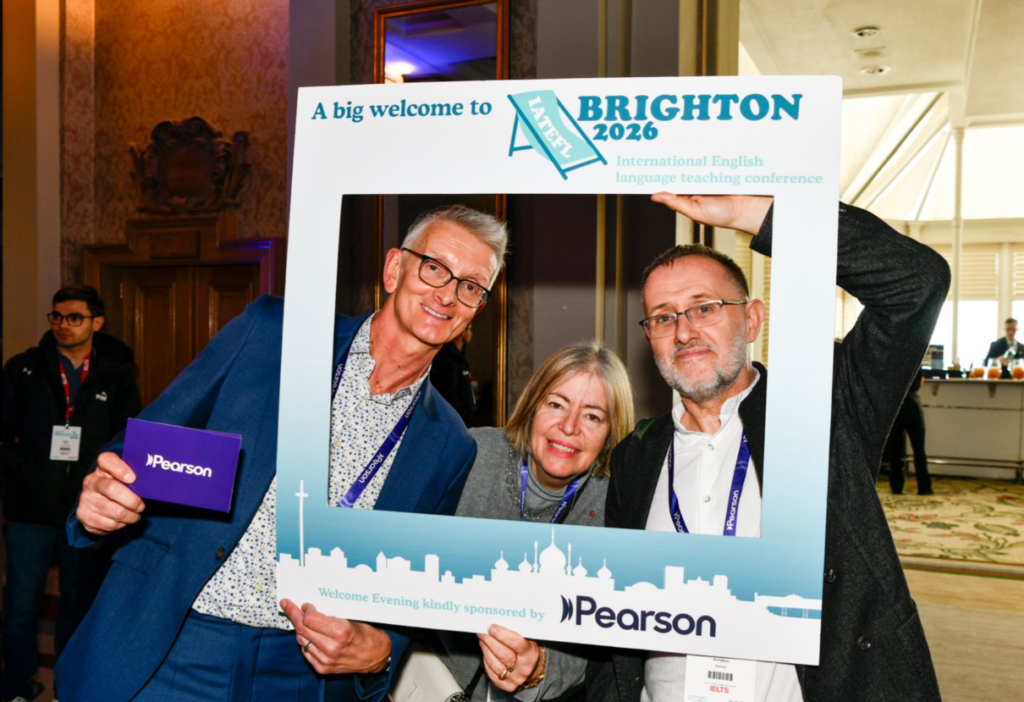
Later in the afternoon, we spoke with Mike Mayor, senior director of the Global Scale of English at Pearson, who, when asked to sum up one of the key concerns of the conference, smiled and said, “no big surprise, AI.” He had just returned from delivering a signature event, Learning Integrity in the Age of AI: Can Formative Assessment Keep Up? Equating an AI ban to trying to ban the calculator back in the 1970s, Mike argued educators must embrace AI literacy to bridge the gap between education and the workplace. Expressing his optimism about the future of tech in the classroom: he said, “If we flip this problem on its head, it’s a massive opportunity.”
For context, Mike explained that Pearson learning scientists analysed nearly 80 million student interactions with its AI study tools and found that when AI is designed responsibly and grounded in learning science, it does not cause cognitive outsourcing – it actually strengthens how students learn. Specifically, the research revealed that a single AI study tool interaction in a standalone Pearson eTextbook made it three times more likely that a learner would be classified as an active reader. Active reading describes a set of strategies effective readers use, such as highlighting, taking notes,and asking clarification questions –
behaviours strongly associated with deeper comprehension, stronger retention, and improved academic performance.
Chief among Pearson’s offerings in this area is the Smart Lesson Generator, a tool designed
for curriculum-aligned, hyperpersonalised lesson planning that delivers bespoke materials and teacher’s notes in seconds. Now available to over 47,000 educators, teachers have told Pearson it is saving up to 45 minutes per activity. Mike continued, “the beauty of not using open AI and using something from a learning company is that it has all the learning science baked in, so it’s at the right level and you’re not getting inappropriate content coming out.” Looking ahead, Mike concluded, “This is an amazing opportunity for teachers and there is
a lot of forgiveness around failure in this area. Our message is, try these products, don’t close yourself off to them, try them and learn”.
Trinity College London
At this year’s conference, Trinity hosted a special event to mark the launch of Your Way to GESE, Trinity College London Press’ first-ever series of dedicated, young learner GESE coursebooks. The series follows the characters Lily and Chen as they progress through
their English language learning journey, from beginner (CEFR pre-A1) to elementary (CEFR A1). “We’ve had great feedback from teachers already, with one saying they’ve started to use it in lieu of their actual school course book,” shared Dr. Ben Beaumont, head of Teacher Education and Pedagogy. Trinity College London is an international awarding organisation
and educational charity that has been delivering performance and communicative assessments since 1877. It is widely recognised for qualifications such as GESE, ISE, and their TESOL certificates and diplomas. Ben discussed how they are refreshing the historic Diploma in TESOL – originally launched in 1968 – to ensure it continues to meet teachers’ emerging needs. This includes replacing the three hour handwritten exam with a
contextualised, locally written essay and tutor-led professional discussion, increasing accessibility and introducing dialogue into the assessment. “We wanted to reflect
the role of human interaction in learning and teaching,” Ben explained. “And for teaching
observations, assessors have a discussion with the teaching candidate before and after the lesson, enabling assessor and teacher to better understand the lesson plan and learner achievement.”
Reflecting on the shifting attitudes toward educational technology at the conference, Ben noted a distinct change in perspective. “The feedback I’m getting is that we’ve come back
from that knee-jerk reaction of ‘everything needs to be online’ to a more balanced approach. At Trinity, we’ve always valued the role individuals play in learning, so we really welcome a more judicious use of AI as part of teacher supported learning.”
Conclusion
Speaking to EL Gazette after the event, IATEFL’s Jon Burton emphasised the event’s lasting
impact: “Ultimately though, despite the professional development opportunities it presents, the truth is that a successful conference is about human contact. About being, and feeling, part of a community. About building professional relationships. About finding your tribe! We hope we achieved that in Brighton, and we are looking forward to doing so again next April in Birmingham, where we’ll
be celebrating 60 years of IATEFL!”
This article was originally published in the May/June issue of EL Gazette.