

Wayne Trotman continues this series which began with Moldova in
EL Gazette’s July/August issue and which spotlights countries language teachers might think about investigating for both work and travel.
Situated at the foot of the Caucasus mountains, Georgia is a delight to behold. I’ve been fortunate enough to have visited Georgia a dozen times in the last five years, and although I’ve lived and worked for short periods in thirty-seven other countries, I don’t think I shall ever experience a more fascinating part of the world. Along with Moldova (see EL Gazette’s July issue) it’s a place I would love to spend more time in. Although surrounding areas are still pretty volatile, (yes, Chechnya, and South Ossetia, I’m talking about you!) Georgia itself is currently stable. However, as with Moldova, another troublesome former Soviet Union republic much further west, Georgia is keen to throw off the Russian yoke and join the EU. In recent years this has not been without periods of nightly demonstrations outside the parliament building. I can vouch for these since, unfortunately, I had booked a hotel across the road and was able to view the water cannons and tear gas both on my TV and out of the window.
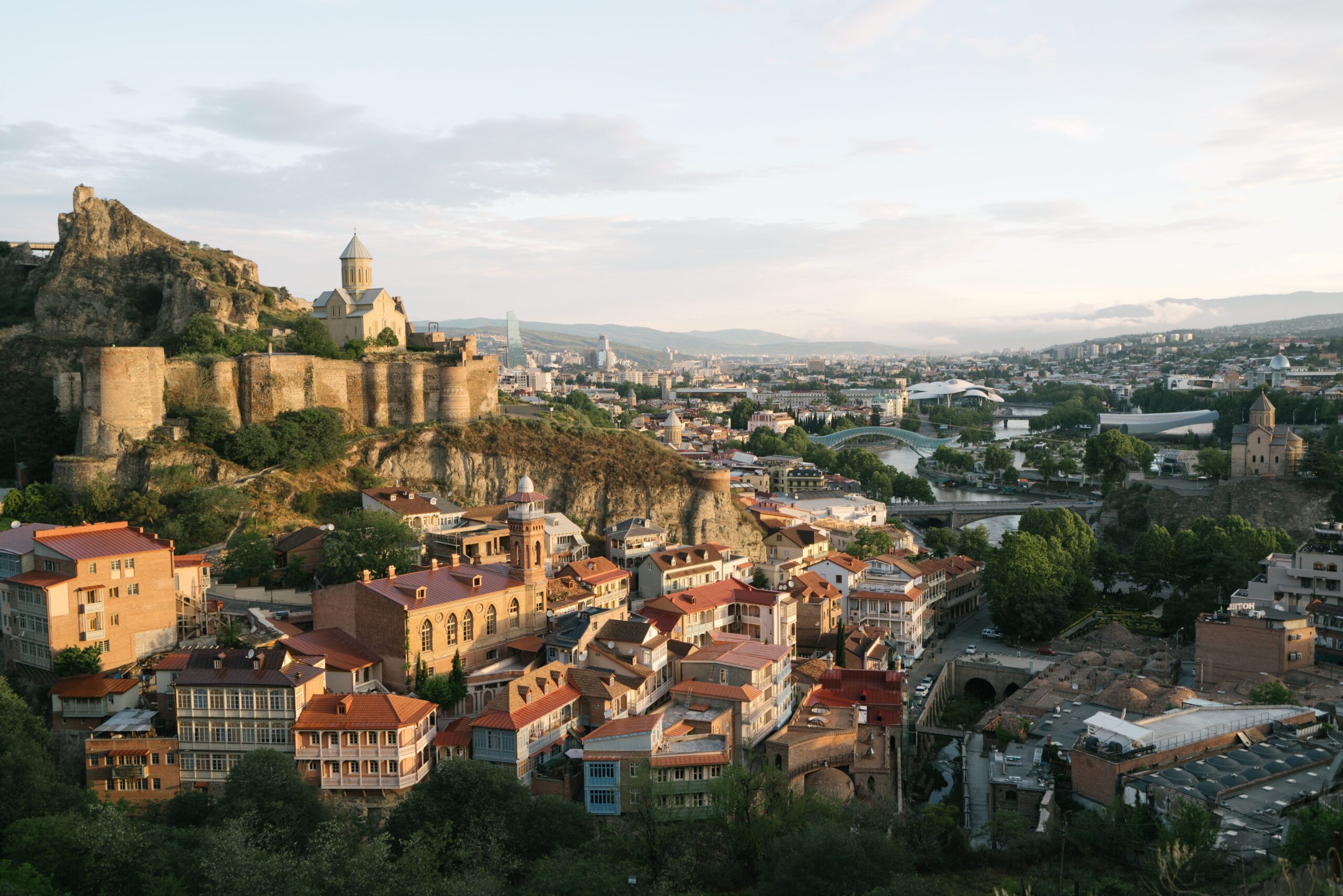
The capital is Tbilisi, which translates as ‘warm place’ in Old Georgian. The name refers to the city’s natural, sulphureous springs. If steamy baths are your thing, then a visit to those below Narikela Fortress is highly recommended. Other things not to miss are the cable-car rides and the Old Town. Since the latter is becoming increasingly touristic you might look into becoming a tour guide on your days off from the chalkface. Or you could simply stroll up and down the main street that divides the city – Shota Rustavell Bulvar: a lot of places are named after this iconic Georgian poet. Beneath the city centre is a somewhat bleak shopping arcade that provides welcome shade in summer.
Batumi is a rather sedate fishing resort just across the border with Turkey. Curiously, it has a tropical micro-climate in which bananas grow, but out of season there’s little to do apart from enjoy a curry at one of the many Indian restaurants there. Other attractions include the wonderful botanical gardens, a very scenic cable-car ride and an Armenian church that all visitors seem to feel the need to photograph. Mention the small town of Gori in north-west Georgia and you’ll be reminded of its best-known former citizen, Joseph Stalin. Be cautious with your comments about him, though. To many he is still a revered figure; others, especially those who for no reason were exiled, have a lesser opinion of him.
As for ELT employment prospects, The British Council are very active in Tbilisi. Since their office is in the city centre and close to the parliament building, they’d be a good place to investigate potential employment. Just out of town, International House (hidden behind a restaurant called Wendy’s) is a busy teacher-training centre where, if career progress is your aim, you can sign up for the DELTA. If you’re already qualified, maybe call in and investigate prospects. There are many private schools in Batumi and the American International School there would be my first choice to visit.
Communicating with the locals might be a frustrating affair at first, since Georgia is one of only three nations in Europe which has an alphabet unique to itself. (The others are Armenia and Greece, but I’m sure you knew that already). Known as Mkhedruli, the unique modern Georgian script is highly distinctive; and it’s surprisingly easy to read once you’ve managed to crack the curly code. Georgian has many words that begin with combined consonant sounds, such as ‘water,’ which starts with three consonants: (ts’q’ali). More extreme examples include ‘trainer’ (mts’vrtneli) which starts with seven consonants. A few phrases you’ll certainly find useful include: Gamarjoba = Hello; Ara = No; Diyak = yes; Didi madloba = Thanks very much; Nakhvamdis = Goodbye.
The currency in Georgia is the Lari (ლ) (GEL). As with most countries in the region, commission-free exchange offices are everywhere, so forget about changing money on the way in, (especially at Istanbul airport where you’ll be lucky if you get 60% of the official bank rate.) Currently one pound sterling will bring you 3.5 GEL – enough for three single tickets on the Tbilisi metro. A decent salary for a language teacher would be 1,500 to 2,000 GEL (425 – 575 GBP). A more than decent bottle of wine will cost you around 4 GBP. Concerning the cost of living, Georgia ranks very close to Moldova, both of which are much cheaper than countries in western Europe, especially the UK.
Public transport in Georgia also includes municipal buses and ubiquitous marshrutkas (minibuses). Local rides cost 1 GEL. Intercity travel relies heavily on the railway, and the journey from Tbilisi to Batumi, one of five hours and which runs along the river plane at the foot of the Caucasus mountains, is an absolute must if, like me, you’re a train enthusiast. Journeying to and across the northern borders is inadvisable. Read journalist Tom Parfitt’s award-winning High Caucasus if you don’t believe me.
Georgian cuisine tends to be heavy: Khachapuri, which appears prior to most meals is very similar to börek in Turkey, or plaçinte in Moldova; it is bread covered with melted cheese. Khinkali (“hinkali”) is boiled dumplings filled with meat. Other delicacies include lobani (bean-filled bread), and pkhlovani (spinach pie). Articles concerning fine wines very often compare those in Georgia and Moldova. If you’re feeling in the mood, free samples are always on offer at Tbilisi airport duty-free. In particular, I recommend Badagoni wines. Although it would have a very different meaning for those not living there, people in Georgia like to brew their own ‘chacha’ a potent, clear grape pomace brandy similar to Italian grappa. Ranging from 40% to 60% volume, this is distilled from the fermented skins, seeds, and stems left over from winemaking and is affectionately known as ‘vine vodka’. I can’t think why, but I was once offered this free with breakfast by the waiter at my hotel in Batumi; I graciously declined as I was on the way to work!
Fun facts to end with: Georgia is referred to as Sakartvelo by most of its citizens, and most surnames there have endings like –dze (‘son’), or –shvili (‘child’). Rugby is played to a relatively high standard in Georgia, and its popularity is attributed to the local game called ‘Lelo burti’, which is similar in style. There is no ‘F’ sound in the Georgian alphabet; if your name is Frank, you’ll be proclaimed ‘Prank’ by the locals.