



Sponsored study visa grants have decreased over the last two years, with the largest falls due to the decline in dependants of students, says the UK Home Office.
Data from the latest Home Office ‘Immigration system statistics quarterly release’ relates to the year ending June 2025 and all comparisons are with the year ending June 2024 (unless indicated otherwise).
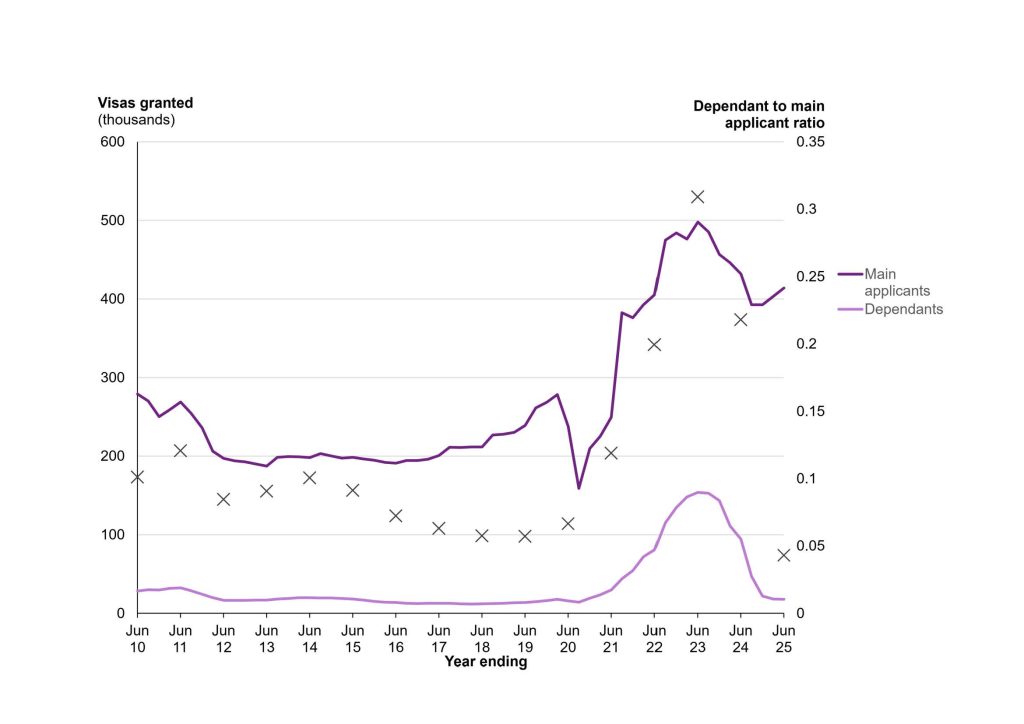
In the year ending June 2025, there were 431,725 sponsored study visas grants, 18% fewer than the previous year but 52% higher than 2019. This included 413,921 main applicants – 4% fewer than in the year ending June 2024 – and 17,804 dependants – 81% fewer than the previous year.
Between 2011 and 2016 sponsored study visa grants to foreign students and their dependants were relatively stable at around 200,000 per year with the majority (92%) being main applicants. After 2016 the numbers steadily increased, reaching 284,721 in 2019. Following a fall during the COVID-19 pandemic, the number of visas issued increased sharply, reaching a peak of 652,072 in the year ending June 2023, due to increases in both main applicants and dependants. The number of visas issued have since decreased, falling to 431,725 in the year ending June 2025, largely due to there being fewer dependants accompanying main applicants.
The large increase between mid-2020 and mid-2023 was due to a number of factors, including the lifting of COVID-19 related travel restrictions, along with changes to the Immigration System following the UK’s departure from the EU and the introduction of the Graduate route allowing eligible students to remain in the UK for 2 to 3 years. At the same time, the International Education Strategy introduced a target for the UK to reach 600,000 international students per year by 2030.
The decrease in visas issued from 2024 was due to fewer dependants following a policy change for courses starting on or after 1 January 2024, whereby only researched-based postgraduate students are allowed to bring dependants (partners and children) to the UK. The restrictions may also have influenced the number of main applicant visas granted, which also decreased over the same period, albeit to a lesser extent. Policy changes are one of a number of factors that affect visa application volumes.
Figure 1: Sponsored study visas granted by applicant type, year ending June 2010 to year ending June 2025
Source: Entry clearance visa applications and outcomes – Vis_D02
Figure 1 shows that following the increase between 2020 and 2023, the number of study visas fell in 2024 from record levels. There has been an 18% increase in total study visas issued in the first 6 months of 2025 compared to the same period in 2024.
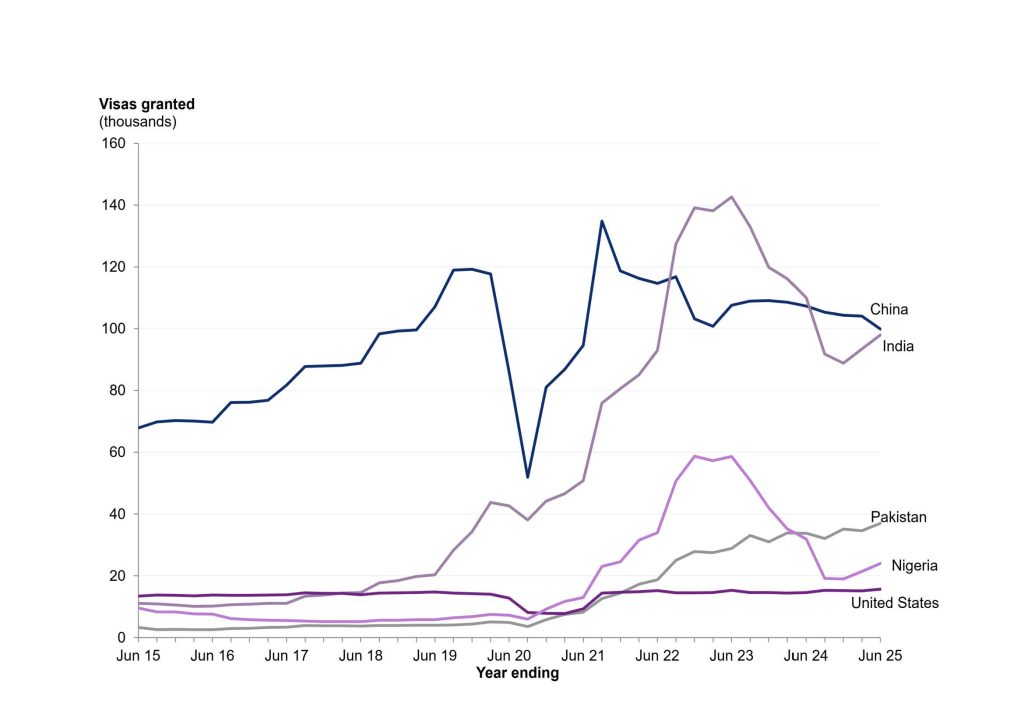
Figure 2: Sponsored study visas granted to the top 5 nationalities (main applicants), year ending June 2015 to year ending June 2025
Source: Entry clearance visa applications and outcomes – Vis_D02
Figure 2 shows the top 5 nationalities in the last 5 years, who together comprised 66% of all student visas. Chinese students saw a notable fall in numbers around the COVID-19 pandemic but are now the most common nationality with 99,919 (24%) study visas granted in the year ending June 2025. Indian students were almost as numerous, with 98,014 (24%) visas granted. The third most common nationality was Pakistan with 37,013 (9%) study visas granted to main applicants.
Both Indian and Nigerian students saw sharp growth between 2020 and 2023 but numbers have since fallen back, largely due to the reduced numbers of dependants.
In the year ending June 2025, grants to Nigerian nationals have continued to decrease, now 25% less than the previous year. Indian (-11%) and Chinese (-7%) nationals also saw decreases in numbers. However, Pakistan and United States nationals saw increases of 9% and 7%, respectively.
The trend in sponsored study visas in recent years has been mainly driven by those coming to study for a masters (accounting for over 60% of study visas over the last 5 years). In the year ending March 2025, 4 out of 5 (81%) Indian students came to the UK to study for a masters level qualification, compared to just over half (59%) of Chinese students.
Extensions of study
The number of study extensions in the latest year remains similar to the previous year, and the majority of those who extend into study routes had previously been granted a study visa.
In the year ending June 2025, 35,181 main applicants were granted an extension of their stay in the UK to study, enabling them to continue their studies or switch onto a sponsored study route. This was broadly comparable to the number granted extension in the year ending June 2024 (34,879). During the same period, 5,985 dependants were granted an extension of stay in the UK, alongside a main applicant, on a sponsored study route) 9% fewer than the previous year.
Study extension grants typically peak in in the third and fourth quarters of the year, likely driven by the timing of academic course start dates.
Chinese (11,999), Indian (6,260), and Nigerian (4,041) nationals represent the nationalities with the highest number of granted ‘student’ extensions in the year ending June 2025. Together, these three nationalities accounted for over half (56%) of all sponsored study extensions, reflecting their continued predominance among those granted study visas in recent years.
The majority (87%) of people extending onto a study route in 2024 previously held another study visa before their current extension was granted, while a further 10% previously held a work visa.
The Migrant Journey: 2024 report shows that of non-EU nationals who initially arrived on a study visa between 2007 and 2014, 14% continued to hold valid or indefinite leave 10 years after arrival. This compares with 23% of those who initially arrived for work purposes and 87% of those who arrived for family reasons, indicating that non-EU foreign students have historically been less likely to remain in the UK in the long term.
More recent cohorts of students appear more likely to remain in the UK beyond the completion of their studies. The 2020 cohort was the first for which students on any course length were able to transfer directly to the Graduate route and subsequently take up employment. For the 2020 and 2021 student arrival cohorts, 57% and 59% respectively continued to hold valid or indefinite leave 3 years later, compared with 39% for the 2019 cohort and an average of 34% for students arriving between 2011 and 2018.
About these statistics
The statistics in this section provide an indication of the number of people who have an intention to enter the UK for study reasons. Further information on the statistics in this section can be found in the user guide. Before 2021, due to freedom of movement for European Union (EU) nationals, the vast majority of UK immigration control statistics related to non-European Economic Area (EEA) nationals. From 2021, unless otherwise stated, the statistics in this release relate to both EEA and non-EEA nationals.
Entry clearance visas allow an individual to enter and stay in the UK within the period for which the visa is valid. Data in this section refers to the number of Entry clearance visas granted for study reasons within the period. If an individual was granted a visa more than once in a given period, this has been counted as multiple grants in the statistics.
Year-on-year comparisons of the number of decisions can be affected by quarterly fluctuations in the data. These fluctuations can be examined in the quarterly data in the published tables. Year ending comparisons will also include impacts resulting from the travel restrictions put in place during the COVID-19 pandemic.
SOURCE: UK Home Office