



Helping students take responsibility for their own progress.
I’ve been having a massive clear out both at home and at work and one of the things I came across was a collection of Learning Journals I wrote for students to use on a summer school programme that I ran for a number of years. These brought back a lot of memories, and I realised that there was something valuable to share here. I’m going to describe a specific implementation of this resource, but you will see that it can easily be adapted for a wide range of contexts, including yours.
Who were the Learning Journals (LJs) for?
The summer school was organized by East Sussex College Group, and we had a regular partnership with a Chinese high school. Every summer they sent us around 30 students for eight weeks to improve their English level, enjoy an international experience and then take the IELTS exam before returning home. The students lived with host families and were sometimes in closed groups and sometimes in groups with other international summer school students. The minimum level was B1 plus, ranging occasionally up to C2. Their schedule was intensive – they did around 40 hours of lessons every week in total, most with our teachers but also with their own group leaders.
We introduced LJs so students could develop:
- greater confidence in expressing themselves and sharing opinions and experiences through speaking
- a strong repertoire of ideas to discuss in the IELTS speaking and writing papers and increased familiarity with reading and listening topics likely to appear on the exam
- their relationships with host families and understanding of the cultural context of the town they were staying in and the UK in general
We also wanted to offer the partner institution something they wouldn’t get elsewhere so we could retain a lucrative contract. An additional benefit is that the LJs made nice souvenirs of their time at summer school and could be shared with parents, who, after all, had paid for the course. We provided LJs for several years.
What is a Learning Journal?
These were spiral-bound paper booklets with card covers in which each double-page spread covered one week of learning on an eight-week programme. Every weekday there was a question for students to talk about with their host family, based on a topic suggested by the scheme of work. These followed themes that changed week by week related to the coursebook unit they were working on, eg The Age of Information or A Healthy World. The weekend topics related to the daytrips they went on every Saturday.
In addition, there were eight prompts at the bottom of the page which students could complete whenever they felt like it. These were repeated on every double page spread.
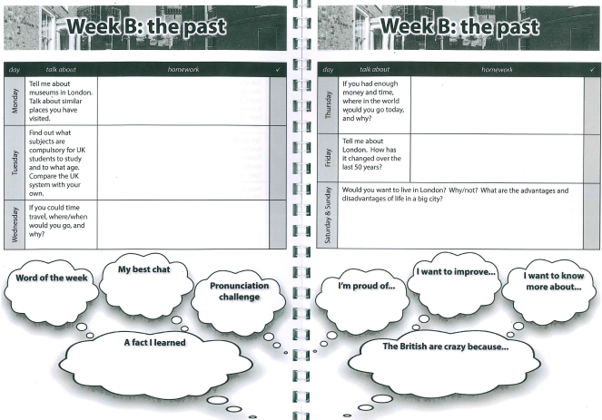
We introduced the LJs during induction and gave students some advice about how to use them, for example, strategies for effective communication and making notes of new vocabulary, how to extend a conversation with question words or repair misunderstandings, and the importance of effective communication rather than 100% accuracy. We also scheduled a regular weekly slot for catching up with the LJs during one of the long afternoon sessions they attended. Finally, we explained that teachers would inspect the journals regularly and at the end of term award prizes for the most complete, the most beautiful and the most reflective LJ.
So, what happened?
Rather predictably, everyone started out with good intentions, but an examination of some “completed” journals reveals that this tended to fizzle out after a couple of weeks. However, enough students persisted for there to be a credible pool of contenders for the advertised prizes, and these were celebrated at an end-of-term event.
Judging from the notes students made, the questions for discussions with host families seemed to be generating long and fairly detailed discussions. Anecdotally, our accommodation team reported that the hosts welcomed this initiative as it made evening chats more purposeful and less burdensome. Students were also motivated to complete the thought bubbles, which made interesting reading.
Perhaps a more structured approach to completing the LJs, with more deliberate teacher oversight, would have encouraged a greater rate of completion. I feel that teacher intervention would be especially valuable for the thought bubbles titled “I’m proud of” and “I want to improve,” as students are often unable to identify their own strengths and weaknesses. However, there is also a case to be made for students assuming responsibility for their own learning at some point; after all, you can lead a horse to water ….
Other adaptations of the LJ idea
Since the original implementation of LJs, I have created other bespoke versions. One was for a training course for teachers of business English, and included a strength, weakness, opportunity and threat (SWOT) analysis for them to assess their own practice, both before and after the course, as well as space to record key points from input sessions and reflections on their own teaching context.
I have also set up versions of the LJ for groups of students on a similar basis to the original scheme, for both online and face-to-face teaching. These were to be worked on during a dedicated slot at the end of each lesson while individual students took turns to interact with the teacher on a 1-1 basis. It was also possible to share the LJs with teachers at home and parents, more or less “live.”
For students on longer courses, I have created both online and paper records of their independent study activities which resemble LJs. Depending on the course, students could make notes about articles they’d read or videos they’d watched, related to course content and often recommended by the teacher. These could also be adapted for book club style activities. Students could record new language they’d encountered as well as how interesting the content was for them, how much they felt they understood, and any questions they had that they’d like to follow up. Students need some training to complete this type of LJ effectively and they also need the motivation that comes with knowing this will help improve their level – this will probably have to come from the teacher initially.
Other variations for LJs could include questions that students generate themselves at the end of a session or perhaps the kind of stimulus you’d find on an exit ticket:
- Three new words I learned today were …
- I can use this grammar/vocabulary when …
- I didn’t realise that …
- I need to practise pronouncing …
- I want to ask …
Conclusion
Keeping a journal or scrapbook as a hobby is a popular hobby these days and capitalising on this trend is a great way to make learning more explicit and visible, both to teachers and to students themselves. It’s productive for students to notice and record new and interesting language, especially where this differs from what the lesson aims were, as is so often the case! When teachers can monitor these thoughts, it enables them to adjust plans for future learning to respond to student needs. Indeed, it introduces the possibility of more “dogme” style activities in response to student-articulated interests.
I feel strongly that the key to success here is that the journals are bespoke to the course; they are especially useful for students who have a high number of weekly contact hours as review activities are more beneficial than introducing extra content when everyone’s tired. They also provide an activity for the inevitable early finishers. It’s also important that the design includes appealing features like thought bubbles that invite and completion (and limit length) and illustrations that reflect the content. Even something that invites doodling or colouring improves engagement. And just to reiterate, students need training to use these and regular supervision.
Why not give learning journals a try with your students?
This article was originally published by Stephanie Hirschman.