

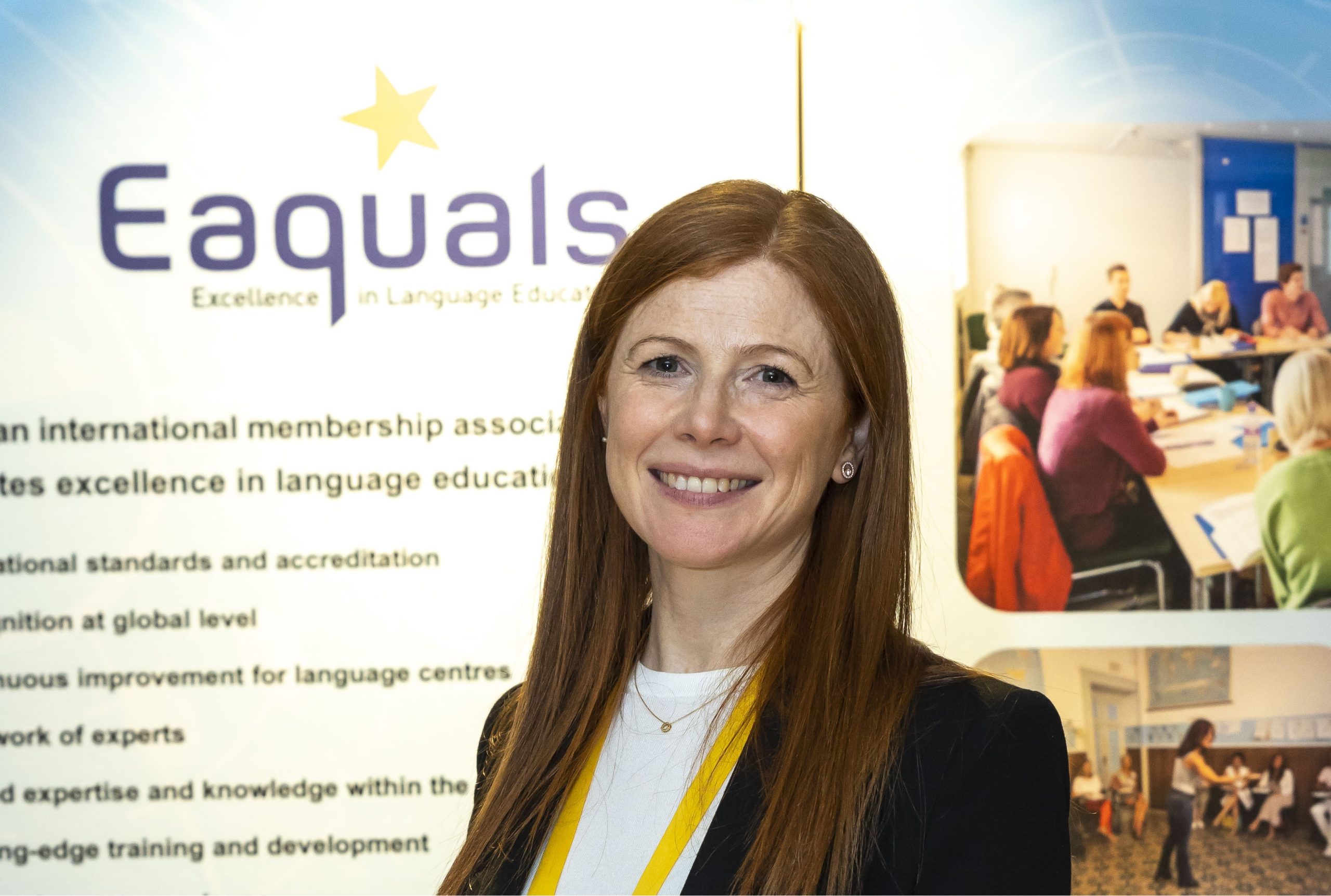
Eaquals‘ Lou McLaughlin has the answers.
A common misconception is that Eaquals only accredits English language providers. In reality, it accredits language institutions providing any languages, not just English, and covers institutions like K–12, higher education, private language schools, and online providers across the globe.
Eaquals’ standards are designed for diverse instructional setups in any country. In fact, it currently operates three accreditation schemes tailored to different types of providers. This ensures that it’s not offering a “one size fits all” approach, but instead recognising and supporting the specific contexts in which institutions operate.
In this interview, we ask Executive Director Lou McLaughlin about the organisation’s strategic vision for the future, including its key priorities, partnerships, and evolving role in the global language sector.
What are Eaquals’ key priorities for the next few years?
One of our main priorities is to expand membership into different geographical areas. Today, Eaquals has more than 170 members in over 36 countries teaching more than 25 languages, and we want to build on this reach. This expansion isn’t about numbers (Eaquals is a not-for-profit organisation) but about raising the bar globally. The more institutions we work with, the more we can ensure that students around the world have access to high-quality language education, and institutions can benefit from Eaquals’ support to strengthen their own practices.
Equally important is supporting teachers. Teachers are at the heart of quality language education, and we want to make sure they always have access to tools and knowledge that will help them grow. Our frameworks play a big role here. For example, the Eaquals Framework for Language Teacher Development helps teachers identify where they are in their professional journey and what training they might need to take their next steps. We also offer frameworks for academic management and language provision, all designed to be practical tools for self-evaluation and growth. These will be a key focus of our upcoming Eaquals Online Conference, which we host virtually and yearly to make it as accessible as possible to colleagues around the world.
We’ve also launched the Language Assessment Professionalisation Programme (LAPP), together with ALTE, a free training course developed after identifying a clear gap in assessment knowledge among teachers. LAPP has already been completed by over 400 educators worldwide, giving them the confidence and skills to design and use assessment more effectively.
In short, our priority is making sure knowledge is shared widely and accessibly. In fact, we have recently launched our YouTube channel where we share recordings of past webinars, and professional development resources. The aim is to open up Eaquals expertise to an even wider audience, ensuring that teachers and institutions everywhere, not just our members, can benefit from the ideas, discussions, and tools we make available.
How does Eaquals work with other major industry bodies?
Collaboration is central to how Eaquals works. We hold participatory status with the Council of Europe, which allows us to contribute to discussions and projects on language education policy at a European level. For example, Eaquals has been actively involved in developing tools and resources linked to the Common European Framework of Reference (CEFR), helping make this framework more usable in classrooms around the world whilst ensuring teachers and institutions have practical instruments to implement the CEFR effectively.
We are also part of the ECML (European Centre for Modern Languages) Professional Network Forum, where leading organisations come together to exchange expertise. This means we contribute to Europe-wide conversations about quality in language education, and our involvement ensures that Eaquals standards remain aligned with broader policy developments.
Partnerships with our Associate Members also give rise to practical projects. A good example is our collaboration with ALTE, where together we developed the LAPP programme in response to the clear need for teacher training in assessment. The positive feedback mentioned earlier shows the real impact of this kind of cooperation.
How does Eaquals ensure its accreditation standards remain relevant and up to date?
Our standards are reviewed and updated regularly. We integrate emerging priorities such as sustainability, digital technologies, and evolving teaching methodologies into our quality framework. This ensures that schools are not only meeting current expectations but are equipped to anticipate future challenges.
Once again collaboration plays a big part in keeping our standards relevant. By working with policy makers, the Council of Europe, and networks like the ECML, we can identify new priorities in our framework. We also benefit from our ENQA membership (the European Association for Quality Assurance in Higher Education). This is important because while Eaquals sets standards for others, we too are evaluated against rigorous international benchmarks. In other words, our own quality assurance processes are held to account, which helps us keep pace with global developments and ensures our accreditation has credibility worldwide.
Can you walk us through the typical accreditation process for a language school? What challenges do schools commonly face?
At Eaquals, accreditation is not just an audit, it’s a consultative and supportive process. From the very beginning, we work side by side with schools, helping them benchmark themselves against internationally recognised standards. As a global accrediting body, we understand that contexts differ, so we adapt our approach while still maintaining global consistency in quality.
The final accreditation report is highly anticipated, not just for the verdict, but it also serves as a blueprint for future development. It highlights areas of excellence but also provides constructive guidance on how the institution can develop further, adopt best practices, and operate more efficiently and effectively. All of this is delivered by experienced professionals with expertise in language education, so institutions know they are receiving reliable, practical advice that can make a real difference.
What trends or “points of excellence” are you seeing in accredited schools? Where are they excelling?
Every accredited institution has to meet the same high Eaquals standards, but what stands out is how quickly and effectively schools adapt to new sector needs. That responsiveness is itself a mark of excellence.
We’ve seen a strong focus on staff and student well-being, with institutions putting in place meaningful policies to support both groups. AI is another major talking point. The technology is still developing, but conversations about its impact are already taking place at institutional and policy levels. Schools are experimenting cautiously, looking at how AI can support teaching and administration without undermining quality or ethics.
Because Eaquals keeps its standards up to date, our accredited schools are equipped to respond to these shifts, whether that’s well-being, AI, or sustainability. And through initiatives like our Member Event Fund, we also support members to host events and discussions on these very issues, creating opportunities to share experiences and solutions across our network.
How do you handle accreditation of both small, independent schools and large, multi-campus institutions? Is the process different?
We currently operate three distinct accreditation schemes, each designed to reflect the realities of different types of providers. This allows us to treat each institution on its own terms, whether it’s a small independent school, a K–12 provider, a university language centre, or an online platform.
While the principles of quality are consistent, the way we apply them is tailored to the institution’s context. A university, for example, may require a stronger emphasis on academic research and integration with wider faculty objectives, while a private language school might focus more on student services and extracurricular activities. Online institutions raise different questions around delivery, engagement, and learner support. Eaquals’ role is to bring the right expertise to each context, ensuring that no institution is simply fitted into a generic framework.
What feedback mechanisms ensure ongoing quality after accreditation? How do you monitor members between inspections?
Accreditation with Eaquals is the beginning of an ongoing process. Between the four-year inspections, institutions complete a mid-term self-assessment. This requires schools to reflect on their progress, evaluate how they are addressing recommendations made during inspections, and demonstrate continued compliance with standards.
But feedback doesn’t stop there. Eaquals fosters an active professional community. Members are regularly engaged through webinars, workshops, conferences, and online forums where best practices are shared and challenges discussed. These platforms create channels for dialogue, allowing us to stay closely connected with our members and ensuring they have continuous opportunities to learn from one another. This active engagement means Eaquals always has a clear picture of what’s happening across its network, and members benefit from being part of a dynamic, supportive community.
How is the global ELT landscape shifting? What challenges and opportunities does this present?
The global language education sector is in transition. Student mobility patterns are changing, often driven by visa restrictions and shifting destinations. Traditional study abroad routes are less predictable, particularly for adult learners, which is prompting institutions to rethink their offerings and seek more creative ways to attract students.
We’re also seeing summer programmes becoming more last-minute and thus more demanding. Students and families increasingly expect language learning to be combined with broader experiences, and providers need to be quick in creating attractive packages at short notice.
At the same time, there’s growing interest from higher education institutions in enhancing their language provision, whether for international students or for their own domestic populations preparing for global careers.
The overall challenge is that institutions must be more flexible, responsive, and innovative than ever before. For Eaquals and our members, this is also an opportunity. By ensuring high standards and sharing best practices across our international network, we help institutions respond quickly to change and deliver high-quality learning experiences, wherever and however students choose to learn.
About Lou McLaughlin
Lou McLaughlin is the Executive Director of Eaquals. She is responsible for leading the Association’s strategy, growth, and development, while ensuring the delivery of high-quality services to its members.
She is a founding member of ELT Ireland and previously served on the IATEFL Board of Trustees as Associates Representative until 2021. She holds a PhD in Applied Linguistics and a range of qualifications in ELT and leadership. Her professional interests include young learner teacher training, teacher cognition, and management in ELT. She is also the co-editor of Children Learning English: From Research to Practice (2015).
This article was originally published in the September issue of EL Gazette.